Modern Quilts, Home Decor, and Handcrafted Clothing

Category — Pattern

The Weekender

Weekender

This post is going to have a lot of pictures. Because when you spend a week making the daunting Amy Butler Weekender Bag, you take a lot of pictures. Those of you that follow me on Instagram got to watch this bag come together a bit more each day. That was a lot of fun, instant support group!

If you aren’t familiar with this bag pattern, it’s kind of notorious for being a {naughty word} to put together. Many people are starting to make this bag using the Quilt as You Go (QAYG) method to avoid all the interfacing required. I might try that next time but for starters, I wanted to stay true to the instructions (with a couple minor changes that I will talk about below.)

I have had this bag on my to-do list for awhile. I almost consider it some sort of sewist rite of passage. I heard it was a challenge and I wanted to see if I could do it. My only holdup was I could never find a fabric I wanted to use. The pattern recommends home dec weight and that is pricier than quilting cotton, so I wanted the fabric to be something I loved. Fast forward to the Sewing Summit. Joel Dewberry was a speaker one afternoon and he brought samples of his new line Notting Hill. As soon as I saw this fabric, I was in love. And then he said it was a Cotton Sateen/Home Dec weight! I knew immediately I was going to use it for my Weekender.

My choice for the lining and piping was a bit of a surprise for me. I know almost everyone out there seems really excited about all the plaids that are coming out in fabric collections lately. I’m not really a plaid person. (ducks for cover) But I just felt like it really complimented the floral print, so I stepped a bit out of my comfort zone and decided to use it.

When I first opened the pattern and cut out the pieces, I thought “Only 4 pieces? This is going to be so easy!” LOL Don’t be fooled. Not only do you cut out multiples of each out of your outer and lining fabrics, you also cut multiples out of 2 types of interfacing (not pictured). I spent several hours cutting.

Based on Stephanie’s weekender, I decided to cut my handles a bit wider (6″).

I was really lucky to have been loaned a cording foot (#60c) for my Bernina by the wonderful Catherine Redford from my local modern quilt guild. This made everything involving the piping SO much easier! I highly, highly recommend using a cording foot rather than a zipper foot for your piping. I’m actually going to buy my own now, it was that awesome.

Also, a general note: I used the pattern-recommended jeans needle for my machine. You have a lot of layers to sew through, and you need the extra strength.

The side panels came together easily, even if applying all the interfacing took forever.

For my second change to the pattern, I once again followed Stephanie’s example and used a shorter zipper, 24″. It was easily available at JoAnns and works just fine for the bag.

So, up until this point, I wasn’t sweating this bag. You make the large front and back. Then you make the top/sides with the zipper and sew that piece to the bottom to make a big circle of fabric. Then you have to sew this circle to the larger front and back panels. I know I’ve read of other people having this problem…they weren’t an exact fit. Now I’m not sure if the problem was I wasn’t using exact seam allowances or maybe the pattern is wonky, but it was a bit frustrating. Add in the fact you are sewing through a LOT of stiff interfacing, well you can see where one might start cursing. ;)

I highly recommend getting some binder clips to hold your pieces together rather than pins. I only had 2 binder clips on hand so I was forced to use pins and now they are all bent and ruined.

Again, I used the cording foot to guide my sewing and it worked great!

Weekender Lining

So I’ve finished the bag. I’m not sure if I’ll ever make another one. LOL But I’m super excited to have it and I’m very happy with my fabric selection. As my husband told me when he saw it “they certainly will see you coming with that.” Yep, it’s not subtle. But I love it.

November 29, 2012   70 Comments

The Ship Shape Tote

Ship Shape Tote 1

Yep, another bag! (And I’m working on a third one right now too, so I hope you like totes.) Last month at the Sewing Summit I was super lucky to have the chance to take Alexia Abegg of Green Bee Design’s class. Alexia is not only talented but also a very, very nice person and I was thrilled to be able to spend a couple hours with her, working on her Ship Shape Tote pattern.

Ship Shape Tote Pieces

We all cut our fabrics at home and I decided to use 12 different prints, rather than 2 like in the example. Each side of my tote has the same set of fabrics, but in a different order. The fabric is a mix of Anna Maria Horner’s fabrics (Field Study, Good Folks, Innocent Crush), Denyse Schmidt’s Chicopee, Bari J’s Splendor 1920, Art Gallery Fabrics Indie and Cloud9′s Nature Walk. For the lining I chose Alexander Henry’s Heath in chocolate and added a bit of Cloud9′s Cut Out and Keep because I didn’t have enough of the crosshatch. The straps are a solid chocolate brown.

Ship Shape Tote 2

This was the first time I’ve sewn with such heavy weight interfacing. I really love the sturdy shape it gives the bag. (Mine’s a little wrinkled right now from being shoved under an airline seat.)

Ship Shape Tote 3

The shape of the tote is great too. The slight angled look is really cool and the flat bottom really lets you put a lot in the bag. I really pushed it to it’s limits when I loaded it up as my carry on on the way home from Salt Lake City.

Ship Shape Tote Bottom

I’m already thinking this will be a great pool bag for the summer. I think it will fit all our beach towels, sunscreen, pool toys and snacks and it won’t tip over and let everything spill out.

Ship Shape Tote 4

For my USA friends, I hope you all have a great Thanksgiving tomorrow! I have so much to be thankful for and I can’t wait to celebrate with family. xox

November 21, 2012   13 Comments

A Friend For My Pillow

A Friend for my Autumn Star Pillow

I decided my couch looked kind of funny with one fall pillow (my Autumn Star Pillow) and one regular pillow. So I made a friend for Autumn Star.

A Friend for my Autumn Star Pillow

I wanted to use the same general fabrics but not the same design, so I made a couple columns of flying geese. I chose to paper piece them because I’m just so much more exact when I use that technique. I didn’t make a tutorial but I did make a PDF of the templates I whipped up to use. You can download it here.

Fall Pillows

I was able to fit 10 on one sheet of paper but you’ll need to print 2 sheets if you want to make a pillow like mine. You’ll have a few leftover. If you’ve never paper pieced before – these are easy! I have a tutorial on the technique here.

I think they look happy together!

November 6, 2012   24 Comments

Glorious Autumn: Autumn Star

Welcome to my stop of Quilting Gallery’s Glorious Autumn Block Hop!

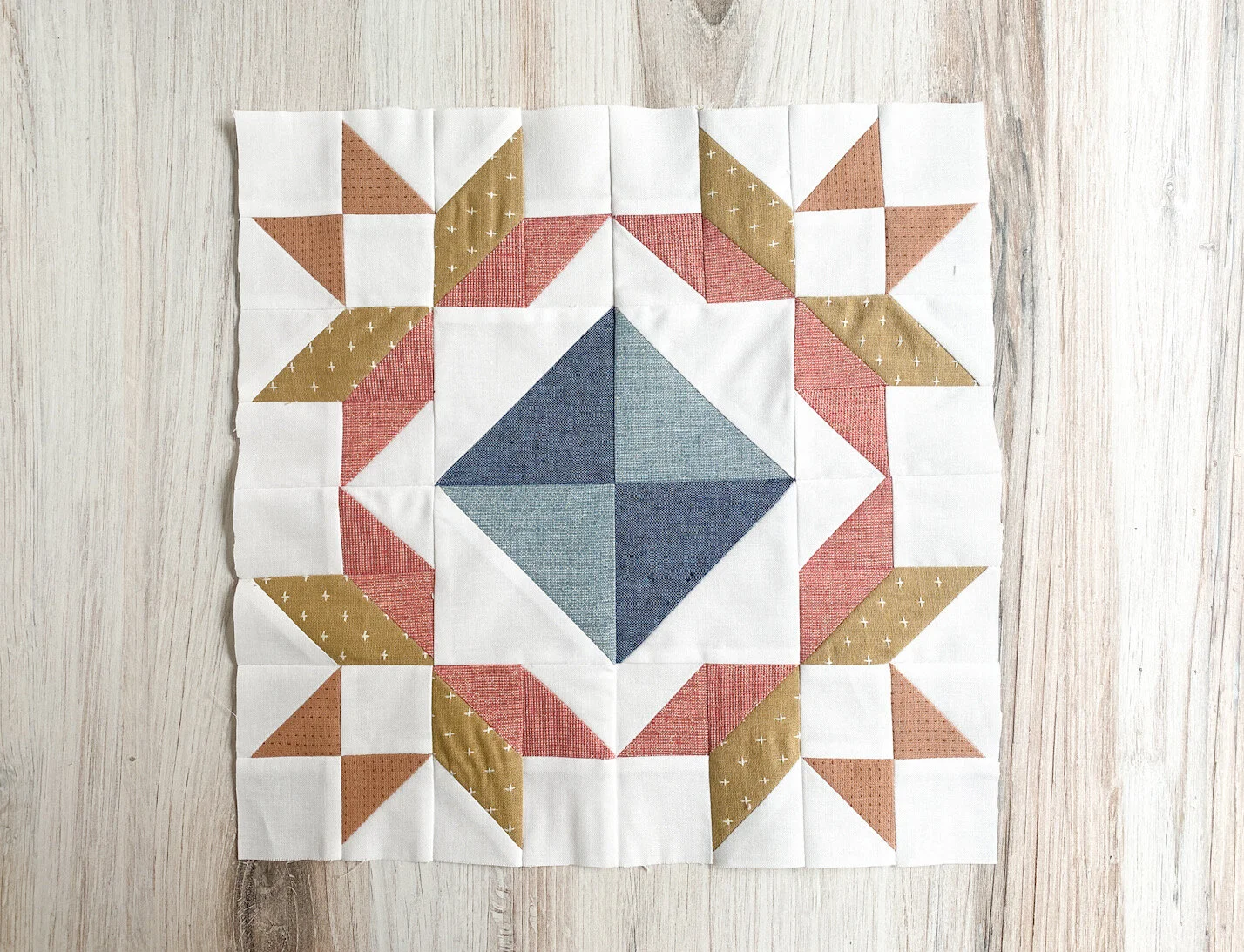
Today I’m very excited to be sharing a new quilt block tutorial with you, the Autumn Star. The Autumn Star is a 12.5″ x 12.5″ (unfinished) quilt square. The background consists of a variety of neutrals, starting from light at the top of the block and working their way darker as you go to the bottom of the block. (Scroll to the bottom of the post to see what I made with my star.) Let’s get started!


Autumn Star Quilt Block Tutorial

Please note, all seams are 1/4″; Final block size 12.5″ unfinished

Step 1: Cut your fabric. I decided to make my quilt block scrappy which meant cutting extra print fabrics so none of my HST (half square triangles) per size were the same. You don’t have to do this, I just liked the look. The below chart shows the minimum requirements for cut fabric. If you’d like your star to be extra scrappy like mine, you will need to cut extra prints per size.

Pattern Piece Color/Print Size Number to Cut
Background Tan/Neutral 1 4.5″ x 4.5″ 1
3.5″ x 3.5″ 2
Background Tan/Neutral 2 4.5″ x 4.5″ 1
Background Tan/Neutral 3 4.5″ x 4.5″ 1
Background Tan/Neutral 4 4.5″ x 4.5″ 1
3.5″ x 3.5″ 2
Background Cream/Text Print 2.5″ x 2.5″ 4
4.25″ x 4.25″ 4
Center Brown/Crosshatch 2.5″ x 2.5″ 1
Outer Star Points Various Prints 4.5″ x 4.5″ 4
Inner Star Points Various Prints 4.25″ x 4.25″ 4

Step 2: We will first assemble the inner star. Take your (4) 4.25″ x 4.25″ inner star point fabric and your (4) 4.25″ x 4.25″ cream/text print background fabric and cut them diagonally into HSTs. Pair up 1 of each print HST to 1 of the cream/text HSTs.

Step 3: Sew, right sides together, down the long end of the HSTs.

You should now have 8 squares.

Step 4: Trim your (8) squares to 3.5″ x 3.5″.

Step 5: Using your quilting ruler, cut your squares diagonally in the opposite direction as your sewn seam, as shown below. You will now have (16) HSTs. Set aside 8 of these to use, and 8 for the scrap bin.

Step 6: Because I wanted a scrappy look, I decided to lay out my inner star points until I was pleased with the colors.

Once you are happy with the look, sew each of your HSTs together to form hourglasses as shown below.

Step 7: Trim your blocks to 2.5″ x 2.5″.

Step 8: Take your (4) 2.5″ x 2.5″ Cream/Text Print squares, your 2.5″ x 2.5″ Center Square and your (4) Hourglass squares and lay them out like a 9 patch, as shown below.

Step 9: Sew the squares together into rows.

Step 10: Sew the rows together to form a 6.5″ x 6.5″ square.

Step 11: Now we will make the star points for the outer star. Take your (4) 4.5″ x 4.5″ outer star point fabrics and cut them diagonally into HSTs.

Take each of your 4.5″ x 4.5″ tan background fabrics (you should have 1 of each of your shades of tan) and cut them diagonally into HSTs too.

Again, I wanted my block to be scrappy so I laid out my fabrics until they were just right.

If you are doing the varied shades of tan like me, keep in mind that your top row is your lightest fabric and work your way down to the bottom row, your darkest fabric.

Step 12: Sew each of your print HSTs to your tan HSTs, resulting in 8 squares.

Step 13: Trim your squares to 3.5″ x 3.5″.

Step 14: Layout your block using your sewn components and the remaining 3.5″ x 3.5″ tan background squares.

Step 15: Sew the top 4 squares together into a row. Sew the bottom 4 square together into a row. Sew the side 2 squares together into columns.

Step 16: Sew the left and right columns to the inner star you made in the first half of the tutorial.

Step 17: Sew your top and bottom rows to the middle rows.

You’re done! Enjoy your beautiful star!

I decided to add a bit of sashing to my block and turn it into a Fall pillow for my couch.

I free motion quilted the star portion (not the dark sashing) it in a nice meandering design. The backing is a great text print from Sweetwater’s Mama Said Sew line.

I hope you enjoy making your very own Autumn Star. Be sure to check out Quilting Gallery’s Glorious Autumn page for more tutorials, coupons and giveaways!

November 1, 2012   41 Comments